The Magdeburg synagogue community after 1945
After the end of the Nazi regime, only 90 members remained in the Magdeburg synagogue community. 1,500 members were murdered, the rest were able to emigrate before 1939. One of the few survivors was Magdeburg-born Gyula Grosz (1878-1959), a Jewish doctor who was known for his commitment to workers. He survived as a "health care provider" for patients from so-called "mixed marriages" and was able to classify those threatened with deportation as unfit for transport by forging certificates, thereby saving them.
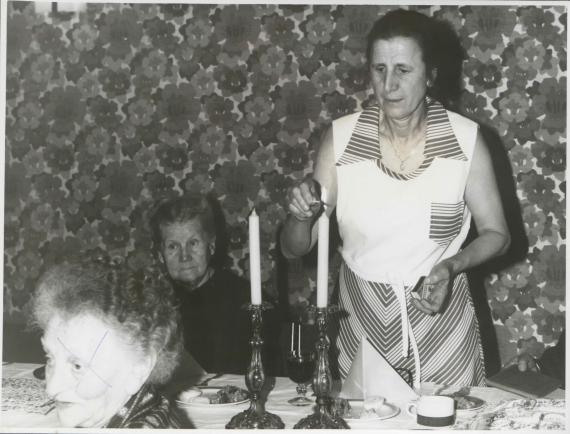
The synagogue community reunited immediately after the invasion of the US troops. It was to be one of eight Jewish communities that existed until the end of the GDR in 1990. The tasks of the newly founded synagogue community under its chairman Horst Ismar Karliner (*1895) consisted of being a "shelter for like-minded people", organizing pastoral care and religious services and mediating between occupying forces and Jewish aid organizations.Jews who remained in Germany after the Nazi era were a minority. Horst Karliner, who was interned in Buchenwald concentration camp during the Nazi era and had to perform forced labor in Magdeburg, decided to stay in Magdeburg, unlike many of his relatives and friends. In one of his letters to them, he wrote that although they had "found a business and a position again, [they] do not feel well, [they] are lonely, as everyone's siblings and relatives were murdered by the Nazi hordes". Karliner fled to West Berlin in January 1953 in the wake of the wave of anti-Semitic persecution.An additional challenge was that in 1947, the community took over the care of 19 provincial communities such as Stendal, Halberstadt, Wernigerode and Tangermünde through so-called provincial representatives. On October 5, 1947, the State Association of Jewish Communities in Saxony-Anhalt was also founded under the chairmanship of Hermann Baden and based in Halle an der Saale. At this time, there were a total of nine communities in Saxony-Anhalt, for example in Aschersleben, where the small community had 30 members.In Magdeburg, community facilities such as the synagogue at Schulstraße 2 had been destroyed. The members therefore held their services in various temporary rooms. For example, a prayer room was set up on the third floor of the apartment building at Halberstädter Straße 113 from 1947. The administration building of the Jewish cemetery at Fermersleber Weg 40-46 also served as the community office. When the community sold the site of the destroyed synagogue in Schulstraße to the city in 1950, it received a house at Klausener Straße 11 in exchange, which it used as a synagogue and administrative building until 1965. The community center has been located in Gröperstraße since 1968, where the State Association of Jewish Communities of Saxony-Anhalt is also housed.
Memorial
A memorial grove consisting of five individual graves was created in the 1960s at the municipal cemetery at Große Diesdorfer Straße 160. Many publications refer to it as a memorial to Jewish victims, while others describe it as a memorial to victims of National Socialism, perhaps even to resistance fighters. In any case, some of the people commemorated here were Jewish.
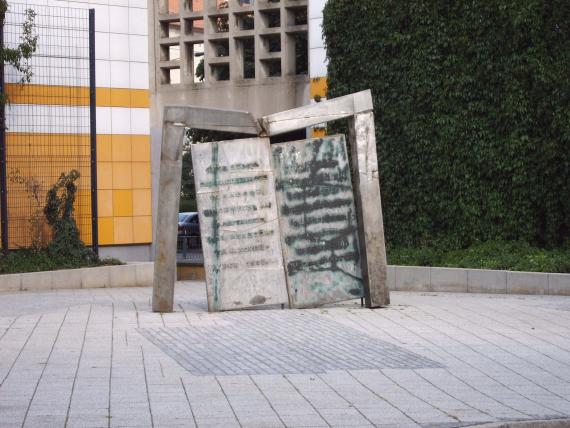
Memorials were erected throughout the GDR to mark the 50th anniversary of the November pogroms. The city of Magdeburg, for example, had a memorial designed by metal artist Josef Bzodok erected in Julius-Bremer-Straße. The inscription on two commandment plaques commemorates the synagogue and the more than 1,500 Jews from Magdeburg who were victims of the Shoah. The words from the Book of Job and two candlesticks can be seen on the reverse. With its reddish surface, the memorial appears burnt. The area has borne the name "An der alten Synagoge" since 1999. Nearby, a relief erected by the "Magdeburgische Gesellschaft von 1990 e.V." has commemorated the synagogue destroyed in 1938 since 2004.Decline and resurgence of the community
The ageing of the ever-shrinking congregations was a problem everywhere in the GDR, but was particularly evident in Magdeburg. Due to the departure of 18 former members of the congregation as a result of the anti-Semitic wave in the GDR in 1953, the congregation shrank from 162 to 44 members in the mid-1950s. This had an impact on community life. From February 1976, the 44 members of the synagogue congregation, the majority of whom were over 65 years old, only met five times a year: on the High Holidays for services followed by a get-together. At the beginning of the 1980s, the Jewish community in Magdeburg only had around 20 members.
From the 1990s onwards, Jewish immigrants from the countries of the former Soviet Union moved to Germany. The influx was also evident in Magdeburg, where the community grew to around 160 members in 1997 and already had over 700 members in 2005.
Since the 2000s, Magdeburg has once again become a place where Jews are both part of the community and live independently of it. In 2005, a liberal Jewish community was founded alongside the existing community. A new synagogue is currently being built - construction began in May 2022 and is due to be completed in November 2023. In 2019, the German Taxpayers' Association criticized the financing of the construction with public funds, which led to discussions. Wadim Laiter, Chairman of the Board of the Magdeburg Synagogue Community, made it clear that it was also German taxpayers who had destroyed the synagogue at the time.
Add new comment