Vilniaus G. 72a
Šiauliai
76283 Šiauliai
Lithuania
Šiauliai was once a predominantly Jewish town and a center of the leather industry with a global reputation.
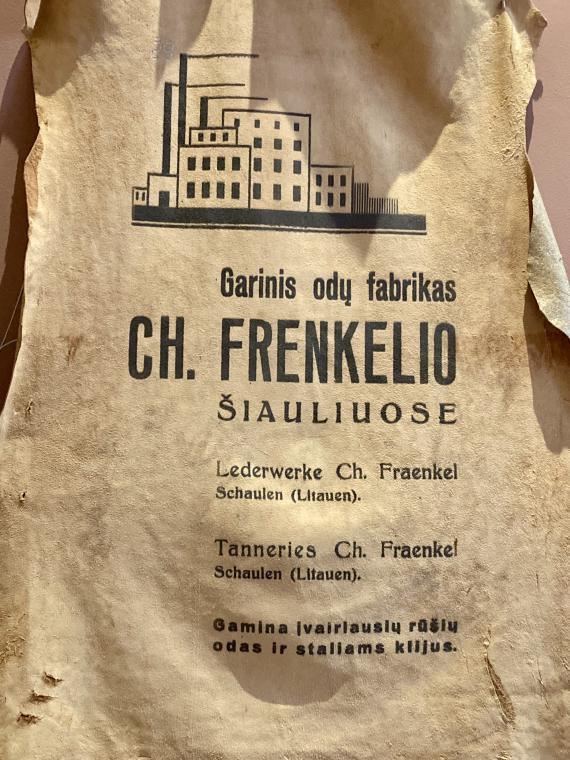
At the age of just 25, Chaim Fraenkel's leather factory dominated the town.
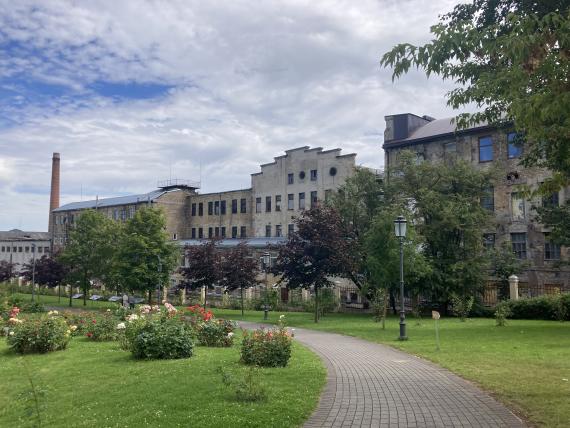
He bought leather tanneries in Šiauliai and erected brick buildings on the Kulpė stream for the future factory, which have been preserved to this day. The factory quickly flourished and was already processing 100,000 bricks a year by 1901. This success was due to the fact that Frenkel was always interested in innovation and looking for better ways to process leather. When he bought the factory, all production was still carried out manually. However, a few years later, leather processing machines were installed in the factory and the first electricity generator was put into operation in Šiauliai. The industrialist was the first not only in Lithuania but in the whole of Russia to import wood from Südamerica for tanning. Fraenkel's son Jacob, who had studied chemistry at the University of Berlin, also contributed to the modernization of the company. The leather from the Fraenkel factory was awarded a gold medal at the world exhibitions in Paris and Brussels for its clever use of modern technology.
The beginning of the 20th century was the heyday of the Fraenkel factory. Before the First World War, the factory consisted of 48 brick buildings and employed around 1,000 workers. Thanks to the success of the factory, Šiauliai became one of the largest centers of the leather industry in the world and Fraenkel became one of the richest people in Lithuania. He generously shared his wealth with others, founded and maintained the old people's home in Šiauliai and opened the first city hospital in Šiauliai. He did not forget the Jewish community either: he built and maintained a religious Jewish school for boys and later a school for girls and helped to procure premises for the Jewish grammar school of Šiauliai. His son Jacob also became a mason: He supported cultural, educational and social projects of an independent Lithuania.
The successful operation of the factory and the Fraenkel family's quiet life were interrupted by the First World War, which began in 1914. The factory was closed, the family moved to Russia and later to Germany. After returning to Šiauliai after the war, Jacob Fraenkel resumed production, but his pre-war success did not continue. Chaim Fraenkel, the founder of the factory, died in 1920, and the Second World War put an end to the Fraenkels' leather empire.
More about the history of the factory and the Frenkel family can be explored in the adjacent museum in the Frenkel family villa.
Add new comment